

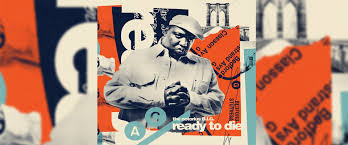
Ready To Die: 30 Year Anniversary of Biggie’s Rise to the Top
Jasmine Meshell
Rap Journalist
On September 13, 1994, Biggie Smalls released his debut album, Ready to Die, the only album released during his lifetime. On the same day, 30 years later, Warner Music Group re-released the record as a double LP. The two sides are titled “For The Money” and “For The Respect”, splitting the record’s main themes onto two separate discs. Born and raised in Brooklyn, New York, Biggie grew up in the rugged neighborhood of Bedford-Stuyvesant, exposing him to the pitfalls of street life early on. By age 15, Smalls was caught in the local drug trade, skipping school, and getting more and more involved in street life. All while making money, selling dope, and getting charged with jail time, he began freestyling on the streets of Brooklyn and quickly gaining a name for himself. His current stage name at the time, Biggie Smalls derived from his large size and a character from the movie Let’s Do It Again (1975) and due to legal issues later having to adopt the name ‘‘The Notorious B.I.G.’’.
When Biggie came into the game, the West Coast rappers were on the rise with Dr. Dre’s The Chronic (1992) and Snoop Dogg’s Doggystyle (1993). All eyes were on the East Coast to take back their power as the creators of rap. B.I.G. just so happened to be the perfect fit for that East Coast crown. The plan was to produce the hardest street album ever to grace the ears of New York and for the world to embrace it. He had what many rappers didn’t—a 22-year life story that only he could deliver. And he did it explicitly, vividly, and completely uniquely.
Ready To Die is a biopic of Small’s life on the streets but it is also about his obsession with security for a better life for himself and his family. It is about the sacrifice it takes to achieve that life, including death. Biggie feared for his life with the release of this album but saw that the risk was worth it. In a 1994 interview, the narrative of the album is best put by B.I.G. himself: “I’m just saying, a n— come out here everyday hustling—risking his life, Risking his life from the police, the stick-up man. Anything can happen to a n— in the streets. So, when I say a n— ready to die, I mean a n— ready to go all out for this. Ready to die for that money. Ready to die for his respect.”

This new LP release is the perfect way to split this album into a more digestible way for younger generations. As someone born 10 years after the release of this album, it’s unconscionable the number of times I have heard how different society is compared to 30 years ago, and yet in many ways not so different at all. People are still just as hateful, hungry, broke, and undoubtedly just as judgmental despite the expansion of open-mindedness passed down from the 90s, this album being one to contribute immensely with-it going 6x platinum since its release. Much of what this country is still enduring and is fighting the government and society to change is exposed in this album through songs such as “Gimme The Loot”, “Juicy”, and “The What” (ft. Method Man). The recording of “Gimme The Loot” is a double narrative featuring B.I.G. portraying two characters: himself embodying an experienced criminal with a strategic plan and an accomplice who provides a younger and less experienced perspective. Biggie illustrates the story in complete detail through a conversation between the characters, to which it is difficult to tell that both voices are coming from one man. “Juicy” is Notorious B.I.G.’s life story bubbled down to a 5-minute track; a classic rags to riches story recounting his journey from a life of poverty and crime to that of fame and riches in the music industry. Interestingly, Biggie uses his track “The What’ to show off his skill rather than tell a story like the two listed above. Him and Method man bounce off each other in perfect harmony spitting out grimy street lyrics using each of their unique wordplay and lyrical prowess. In the last verse, B.I.G. flaunts his wit with the line: “I used to do stick-ups, ’cause h— is irritating like the hiccups” to which he mocks a hiccup-ing sound as he says the word. He was funny and it showed through his music almost effortlessly. This album is so revolutionary for its time due to his vivid narratives, effortless flow, and raw honesty that oftentimes is delivered in a humorous way. Probably the most impactful and unprecedented song on the album is “Suicidal Thoughts” which exemplifies all of these qualities. At the time of its release, people were not speaking so openly about the trials in life that lead to someone wanting to end it, but he did because he knew that people needed to hear it. The song is introduced by a disgruntled B.I.G. being awoken by a call. Progressively throughout the song, his thoughts spiral out of control and as his friend frantically tries to snap him back into reality, a gunshot is heard, followed by silence and a heartbeat slowing down. While the topic had been brought up by other rappers before and after, none have executed it in such a realistic and bone-chilling way.
Ready To Die adds a new depth to a stereotyped minority within society that is predominantly viewed in an unfair and ignorant way. The dual sides of not just one man’s experience but many who have lived in fear of the powerlessness that poverty lends and those who have escaped and now live a life of success. An album that reveals the path taken from a hungry kid, to a surviving criminal, to the hottest new rapper in New York.
On Friday, September 13, 2024, the Ready To Die 2-disc LP anniversary rerelease hit shelves and streaming platforms worldwide. Just earlier this year, The Library of Congress also celebrated by adding the Album to their National Registry. Biggie Smalls opened people’s eyes to a way of life that had never been portrayed so humanely, all while incorporating innately human qualities to the music that feels as though you could be passing him freestyling on the street. He knew exactly how to connect his life and experiences to that of anyone else who would listen to the tracks, Whether living on the west coast or growing up in a rural town, there is always an interrelatedness that attaches to wanting to be more, have more, and do more than that of which you grew up and the tribulations it takes to achieve that.

Post comments (1)
-

1
In My Head
-
play_arrow
In My Head Phantogram & Whethan
-
-

2
Last Escape
-

3
Reason to Pray
-

4
Rabbit season
-

5
Still Do




Anonymous on October 2, 2024
Great read!