

The Hill Country Community Band, Beethoven, and Bonaparte: Exploring Heroism through the Symphony No. 3 “Eroica” in Eb Major, Op. 55

Allyson Bowman
Local Music Journalist
Ludwig Van Beethoven was in his mid-20s as he wrote his third symphony, at the time nearing deafness.
Eroica, translated “Hero” in English, is an overall architectural feat of early modern music; although ultimately overshadowed by his later, more famous works, it was the first of its kind in epic nature and exemplary in the composer’s pioneering of dissonance as a mode of suspense.
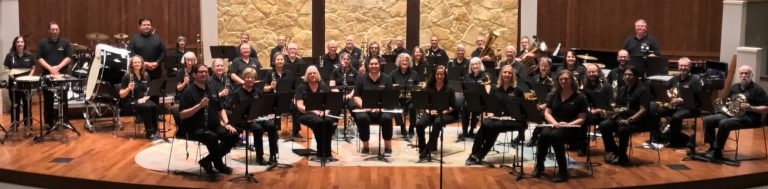
The Hill Country Community Band performed Beethoven’s Symphony No.3 in Eb Major on Saturday and Sunday. Ran by volunteers and funded entirely through donations, the band is currently under the direction of Dr. Manuel Arambula. I had the privilege to speak to him after the concert.
The pragmatic work of Beethoven marks the beginning of a new creative era in Central Europe. Although at first intended as an ode to Napolean Bonaparte, Beethoven however, angrily denounced this dedication after the leader became emperor and failed in protection of his people’s liberties. Eroica then became not a concrete plot of militaristic conquest but rather that of the common man’s heroic journey, bound by spirituality and a strife against struggle.
The first movement is an exposition, best characterized by an unfurled progression and heavy wind instruments. Darker tones lurk, with the movement’s theme containing only six notes total, sparse throughout the band.
“All those dissonances – the accents placed on the wrong part of the beat, that was all deliberate. Beethoven wanted to give an unexpected feeling towards his music, as he never wanted it to be boring from any perspective…. I wouldn’t call them wrong notes, but rather those that don’t exactly fit the harmony and create a sort of uncomfortable feeling for the audience.” – Dr. Manuel Arambula
Largely unheard of in 1804, The Second Movement is a funeral procession; a low beginning in C minor transforms long, drawn-out sequences in tandem with stirring oboe and trombone. Intermittent drums push a gradual, somber close.
The third movement, as told by Dr. Manuel Arambula to the crowd, is a hallmark of Beethoven’s engineering; a scherzo, or “joke” in English, the movement is a fun rhythmic dance of three-paced steps. Dramatic in nature, the movement can be best characterized by a heavy presence of French horns in addition to frequent melodic changes.
“The third movement includes many revolutionary concepts – eventually he expanded on them in his other symphonies, and later composers ended up copying his format.” – Dr. Manuel Arambula
How Arambula procured the sheet music of the fourth movement is actually quite interesting, as the band is only second to have played it in a concert setting – arranged by Momen from Beethoven’s orchestra sheet music, and then compiled by Dr. Mark Rogers from an engraver in Ukraine, the band’s rendition was proceeded by his anecdote of its acquisition and the history of a Viennese-composer duel in which Beethoven ended victorious.
“Back in the day, whenever somebody transposed from orchestra to band, they didn’t have music software like we do now. They would do everything by hand, by scribbles.” – Dr. Manuel Arambula
The concert concluded with Alex F. Lithgow’s “Invercargill March” of New Zealand- and, as Dr. Arambula told me later, the inclusion of marches to close out a concert is absolutely heritage of any symphonic band.
“The earliest bands, in very raw form, were to lead people into battle, to march towards something. I truly believe every performance from a concert band should include a march.” – Dr. Manuel Arambula
Similar posts

-

1
In My Head
-
play_arrow
In My Head Phantogram & Whethan
-
-

2
Last Escape
-

3
Reason to Pray
-

4
Rabbit season
-

5
Still Do




Post comments (0)