
The South, New York and Rock N’ Roll: An interview with Badger Hunt

By Lillian Jones
Station Manager
The beauty of SXSW, although its more corporate changes in recent years, is that it brings independent artists from everywhere to one place. Whether they are playing official or unofficial shows, musicians come to Austin to share the artistry that they love! Annually, traffic worsens as Austin residents, neighboring Texans and tourists from out of state or even out of country, all travel downtown to experience the chaos of the mid-spring festival. This means meeting new people, making new friends and even running into old ones.
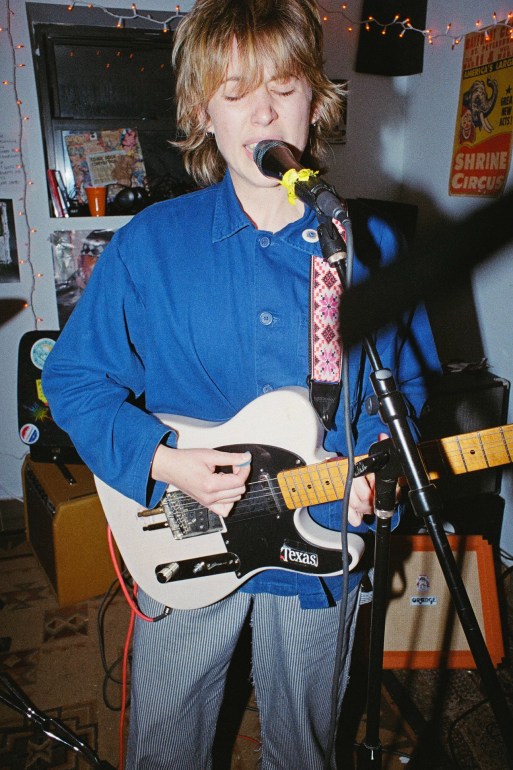
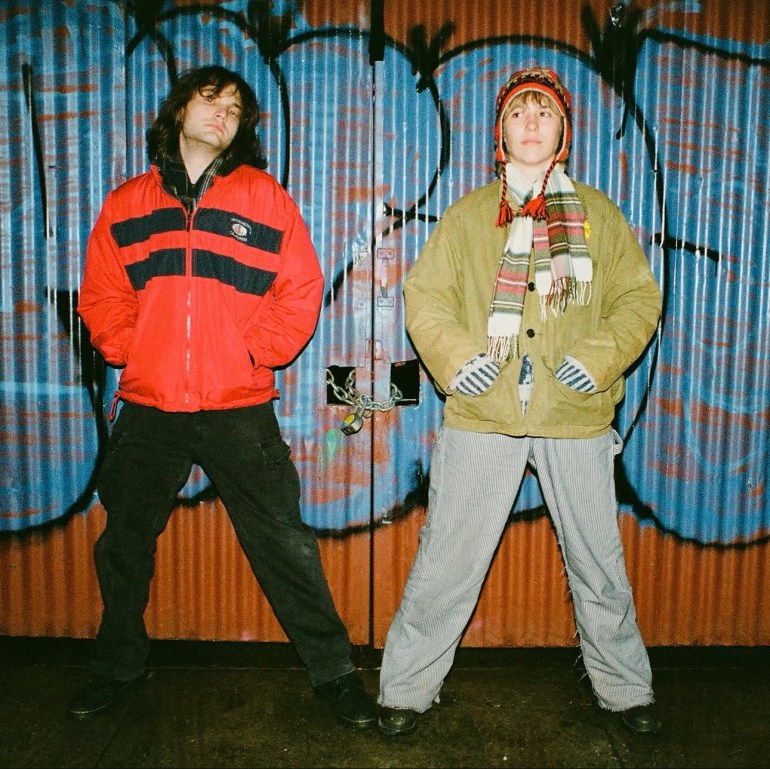
As I stepped into Alienated Majesty, a bookstore off of Guadalupe St. that regularly hosts live music, I was met with a familiar face. My high school buddy, Miles Ellisor, was hollering into a microphone and tapping a tambourine on their foot as they played rapidly on their guitar. Miles had moved out of Texas after high school to attend NYU in New York. Accompanying Miles, was their friend Jamie Walker pounding on the drums. Jamie, originally from South Carolina, met Miles at college. Together, they make Badger Hunt.
Badger Hunt is a dynamic duo, bringing back stripped-down, good ol’ fashion, rock n’ roll. They recently released their first LP, Full Moon In My Pocket, strictly on BandCamp, YouTube and various radio station airwaves (including KTSW 89.9). Getting to see them perform, their sound does not fluctuate much between live and recorded. In both scenarios, they are loud, energetic and spontaneous. Truly, a rambunctious duo eager to produce art and share it with their community.
After their set, I got to catch up with Miles, meet Jamie and learn more about their Badger Hunt adventures.

L: Being from Texas and South Carolina, but being based in New York, how have those environments influenced your music?
M: I feel like I’ve never left Texas. You can take the kid out of Texas, but you can’t take the Texas out of the kid. I just have a ton of Texan pride, as does literally everyone else from Texas.
I used to hate country music, because I thought it was just Florida Georgia Line and that’s it. But then in high school when I was probably 16, I started really liking country music. Honestly, it’s so beautiful. And then I started writing some myself and I feel like everything I write, it just has a little bit of something twangy in it.
We also were a country band for a couple months and now we’re like this instead. We hurt your ears and give you tinnitus.
L: You definitely still have folky influence though.
M: A lot of the songs we play are originally folk songs I wrote and then converted them into rock and roll songs.
J: When I was growing up in the south, I didn’t like it very much. Not that I didn’t like it, it’s very beautiful in South Carolina and every time I go back, I’m like “ahhh I’m home,” but there is kind of a dominant culture and type of person who fits in there. I never really considered myself someone who really fit that mold. Growing up, I was like, “I really want to get out of here”. My dad’s family is from Connecticut, my uncle and cousin lived in the city for a long time. It was always a distant, “ah I gotta get up there,” and now I got up there. You definitely miss things that you wouldn’t expect to miss.
I feel like also with the south there’s generally that culture of I can talk sh*t about it and say it’s a racist sh*t hole, but if someone not from there starts talking sh*t I’m like ,”hey!”
M: But honestly, it is a racist sh*t hole!
J: I think sometimes I have to recognize that it’s a privilege for me to not be there anymore and there’s a lot of artistic, very creative, kind, awesome and queer people who don’t fit in there that don’t have the option to move away. They’re still doing their thing and building community down there.
M: That’s true, it is totally a privilege to be in New York where it seems like everybody is queer as hell and you don’t feel like a freak walking around.But I also feel like Austin itself, specifically, is in some ways a bubble from a lot of the homophobia and transphobia in most other parts of Texas.
L: How has New York specifically influenced your music?
J: Once you learn about a lot of the downtown art scene, there’s always the obligatory Velvet Underground mention.
M: Yeah come on. Bananas!
J: You get a certain perception of what art and music can be. You find out that and you’re like “Woahhh, I wanna be a part of that.” It’s not the same, it’s not, but it is still very cool to witness it and be a part of it. If you’re the kind of person who’s into art or anything kind of creative, that’s the place that everyone’s trying to get to. So you witness a lot of cool stuff.
M: Yeah, there’s always something going on, all the time.
J: The amount of people is awesome too. You just can’t stop meeting really dope people!
M: I wanna say too, on the Velvet Underground, in 2021, me and my friend, Alexanna, we went to Austin Film Society and saw Todd Haynes’ Velvet Underground documentary and it actually, as cringe as it may sound, totally changed my perception of music. They were just making noise and I was like, “why does it kind of sound bad, but awesome!” I realized actually anyone can do this and everyone’s doing it all of the time. I remember we went straight home, turned on the keyboard and she got the guitar. It was like monkeys playing with fire and we found out that if you play C, both at the same time, that it sounds good. And I was like, “Holy sh*t! Music theory! Music theory!,” and we started playing stuff and it was awesome.
I think being in New York was harder at first, because Austin has a super tight-knit scene. Like you learn about one band, you learn about 17 bands. Then going to New York it was like there’s not a scene? Question mark, there’s not a scene? At least to my perception, it’s just a ton of little pockets.
J: It’s very fragmented and I don’t want to say clique-y. I think it’s just because of what I was saying earlier that everyone who wants to be in a band, moves there, so it’s a little oversaturated in that sense.
M: But then it’s like hard to find bands sometimes.
J: Yeah, it’s a paradox.
M: Being in New York, you’ll meet new people and hear sounds you’ve never heard all the days long and I think that’s helpful for writing music. I’m hungry.
L: Miles, how does being in a band, Fan Club, in high school compare to being in a band in college?
M: Oh my gosh, I don’t know if I’ve even gotten better at an instrument, but it just feels so much better. That’s like the dumbest sh*t I’ve ever said, but in high school, you’re just f*cking around and you can’t even play at some venues because they won’t let you in. I always felt super young and it felt out of reach sometimes, because it was like, “I can’t play with these guys, they’re old enough to be my parents,” and they were probably four years older than me.
J: They’re our age now. These washed old people.
M: Honestly, I think this is something I’m still trying to figure out. Why does it feel so different? At least with us, putting out music is more realistic, making physical paraphernalia of our music is more realistic, like tapes, CDs, shirts, buttons, that’s not really something I was doing in high school. And we actually have the ability to move around now and we might be going on t.o.u.r over the summer. Knock on wood… *knocks on head*. I think it’s opened up a lot of things and just being a little older and your brain is more developed. You have more capacity to write songs that are a little more coherent.
L: Jamie, when did you start playing music?
J: I’ve been playing the drums since the 3rd grade. But, I went to a Christian high school in a smaller southern town, Greenville, South Carolina. It’s nothing like Austin, where you compare it and there’s all this concentration of art and music going on.
M: And a crazy history of art and music.
J: It wasn’t that kind of vibe, but I knew how to play the drums and always loved rock and roll and that kind of music. I taught myself how to play the guitar and I just wanted to be in a band. So finally, in junior year of high school, it was the classic drum kit in the garage and I’d amassed enough stuff over the years. Just from collecting, like I wanna learn the bass, so I got a bass, then I wanna learn guitar, so I have all this stuff and I just drafted people. There was this kid, Smith Stanford, who wanted to be in a band, so I was like, “here’s a bass guitar, here’s a video called How to play the bass, I’ll see you next week.” So yeah, my friend sang and my other friend played guitar and we did the little high school cover band thing. It was a lot of fun! We played at just some high school homecoming parties and we booked a local show for ourselves at a local bar during the summer time. We were called, Women Want Me, Fish Fear Me, which is hilariously bad and I don’t think we played a single original song. That’s like a whole scene down there. There’s a big cover band scene.
M: Such an awesome name. And also I just wanna say, and I’m sorry for saying this, but once people get out of high school, there’s no excuse to be a cover band! Write your own songs! Unless you’re like Beatles or Beach Boys impersonators, that’s different, that’s fine. Like yes I want to hear those 57-year-olds play “Good Vibrations” perfectly. H*ll yeah.
J: Yeah, once I got to college and we started playing all of our own songs, it was like, “Okay I’m really doing the thing. I’m a much different person at 22 than I was at 17. So blindingly obvious, but I think moving somewhere very different and having to float around New York on your own, you just understand life a little bit better. Not perfectly, but I guess you never will.
M: I also felt like I was acquiring instruments over time and learning different stuff. I didn’t learn the guitar until the summer before college and started playing that a lot and then being like, “the hell is a power chord?” But I honestly think learning the guitar was a big turning point for me because it’s a lot different writing a song on guitar than it is on bass. Lowkey, I don’t play the bass that much lately.
J: Bass is like if guitar and drums had a baby.
L: Badger Hunt originally started as a solo set, so how did Badger Hunt become the duo that it is today?
M: Ready? I got an acoustic guitar and I started learning songs on there because it was a lot easier to play in a dorm than an electric guitar. So then I was playing that all the time and I was trying to finger-pluck or learn different chords and in the process would write a new song to learn a certain skill. Then I was in this band, Dogtooth, which used to play a bunch of shows with Jamie’s band, Mudskipper, both of those bands are dead now. Around the time those bands started to slow down a bit, I got a 4-track and Jamie taught me to use it. Then I recorded a bunch of those acoustic songs during the week before spring semester, in January 2025. Then Jamie helped me digitize those songs and master them and then I put them on BandCamp and that was super fun. Then actually the first couple of shows we played as a country band where I was on acoustic guitar and you could never hear it. Then Jamie was on drums and our friend Eamon was also on guitar and our friend Ban playing bass. That was fun, but they were both freshmen, so when summer came they went home. And then I was like, “Jamie what if we play as a teo-piece?” At the time, I was going through another egg punk phase and having a little moment like eeek, like I was having a little moment where I was like, bleerghh, and we needed to sound crazy. I was listening to a lot of Snõõper – they are not a two-piece at all –
L: I was literally just talking to Mags inside about Snõõper and egg punk so that’s a really funny coincidence.
M: Snõõper’s so epic. I just saw them at Outline Fest and I made a friend in the pit, shoutout Felix. Anyways, so then we started playing as a duo and then we played a show in July in New York and then we played one in Chicago in August and recorded an album there. Then I went to Madrid, Spain for the fall semester to study there and got really feral. I was feral for amplified music and got a lot of shows lined up for when I would be back in New York. We’ve been playing a show like every week this spring semester and now we’re here. Sprinkled throughout, I’ll play an acoustic set. Just me and my acoustic guitar, playing folk songs that we don’t play. And it’s still under the name Badger Hunt and just no one knows, they never know what they’re gonna get!
L: When I first saw your Badger Hunt project, I perceived it as maybe a persona or alter ego, what does Badger Hunt embody to you?
M: I think Badger Hunt is my time to get really feral. It’s honestly, I really enjoy this thing we got going and playing shows is such a nice release. Because we’re a two-piece, there’s nowhere to hide. Absolutely nowhere to hide. I get really antsy and nervous beforehand and all of that energy gets balled up. Then we go on stage and I’m like, “Rahhhhh!,” and just playing really crazy. It’s super fun!
I don’t know if I would call it an “alter ego”, I think maybe it’s more like maturing into the kind of music I like to make. And I would say that these songs are definitely shorter and more primitive than other songs I’ve written before. It has sort of a pop structure with a punk spirit. It’s my favorite band I’ve been in. Every band I’ve had, it ends and then I take something from it and then grow with the next one and I’m really happy with where we’re at currently.
J: The band I was in before this was doing punk songs, but then there would be an 8 minute extended jam session at the end. In moments it worked–
M: They were epic. They were awesome. It was always super fun.
J: It was fun, but it had hit a point for numerous reasons where it just wasn’t happening anymore. I think I always wanted to do something a little more…primitive, I think. My old band was good, because it made me rack my brain where I would be like, “I have to keep this interesting, how can I make it different? Can I switch the time signature? Can I do this?” But at a certain point, it started to feel a bit bloated. So now, Badger Hunt is totally different from that, it’s more to-the-point, kinda no frills. This is the smallest possible band you can be in – I guess one person, but that’s not really a band at that point. There’s nowhere to hide. The songs have gotten shorter. Also the process from idea to song we perform is like *snaps*.
M: Yeah we wrote a song like…48 hours before we got here? Today is Sunday, we wrote a new song on Thursday and we never even played it full through. Then we played it on Saturday for the first time all the way through. And then we played it again today and today was much better.
J: And it will get better the next time we play it!
M: Also there’s nowhere to hide, but we’re both so loud that there kind of is somewhere to hide. You can’t stop playing, but there’s so much distortion on the guitar, he’s going so insane on the drums and and then we’re both doing tambourine and singing and yelling so you can mess around a little bit. It’s not bare bones, it’s pretty full.
J: My father was here tonight and the first thing he said was, “that was a lot of noise for two people!,” like thank you dad.
L: Speaking of the tambourine, I’ve literally never seen someone play a tambourine with their foot.
M: I didn’t get it from anybody. I’m not saying I’m the first person to do it. It was more of a practical thing of, “well I want to play the tambourine, I can’t play it if I have both of my hands on the guitar. I got two more limbs, let me put it on my foot!” It was actually difficult to learn at first, but now I’m pretty good at it. It’s very subconscious and it helps me stay on time.
L: You recently released an LP, Full Moon In My Pocket, on BandCamp, what was your reasoning for only making it available there and not elsewhere?
M:One, streaming, technically BandCamp is streaming and it’s owned by some big corporation. But for one thing, big streaming services don’t pay their artists well and I don’t enjoy that. We’re not doing this to make the big bucks, but I just disagree with it in that way. And then Spotify, the owners are like investing in AI and drones that kill Palestinians and other people around the world. It’s hard to wrap your brain around because it’s like,”Oh! I thought we were listening to music and now they’re making money off of war.” It’s just absurd and terrible. It’s a fraction of a drop in the ocean by us not putting our music on these platforms, but there is a movement toward getting off streaming services. BandCamp is bigger now and there’s Nina Protocol, people are buying CD players and tape players!
J: I got a tape in my pocket right now.
M: I know some people who only have their music on YouTube.
J: I think it’s also the playlist element of Apple Music and Spotify. That way of engaging with music just depersonalizes it. I don’t listen to front and back albums all the time, but there’s that and the model of chasing playlist placement that it promotes is just killing the joy of music.
M: I still have a Spotify account and I’m working towards getting off of it. It does take time unfortunately. They make it hard to get off of it on purpose. I even tried the thing where you transfer all of your songs to this other platform that’s apparently less bad and it didn’t even work! So now I’m between BandCamp, Spotify, CDs, Tapes and going to see them live or singing them to myself on my walks. These days, instead of opening Spotify, I go to Bandcamp and I’m slowly building up my collection, it makes me listen to stuff front to back a lot more and that’s making me care about it so much more. It makes it so much more personal.
J: It’s also maybe an extension of the current Gen Z predicament of everything being in your face all the time where you have all of recorded music at your fingertips at all times. It’s almost the New York paradox where it’s oversaturated, but also more difficult to encounter. We’re not purposefully burying ourselves or not wanting people to find our music. I would prefer our discovery be through playing shows and being friends with other people in the scene, not just pushing our music into random playlists on streaming services. That’s how I’ve discovered a lot of cool music I’ve discovered now. It’s not through algorithms, it’s from existing in the same physical space as people. That’s something we’ve got to emphasize more as a culture.
M: I don’t even think we’ve been buried at all. We’ve had a lot of people – or not like a lot, probably like 8 or less, have played our songs on the radio. And some polish guy uploaded our entire album onto YouTube for some reason. I think the people who do listen to it via BandCamp or tape or CD or YouTube, care so much more than people who would only listen if we had 533 thousand monthly listeners on Spotify.
J: My friend was also like, “yeah I guess that’s a good move because no one knows if you’re big or small,” like you don’t have that marker of streams.
M: It’s like hiding likes on Instagram. I just wanna have fun. I don’t want to look at the numbers bro, I just wanna have fun.
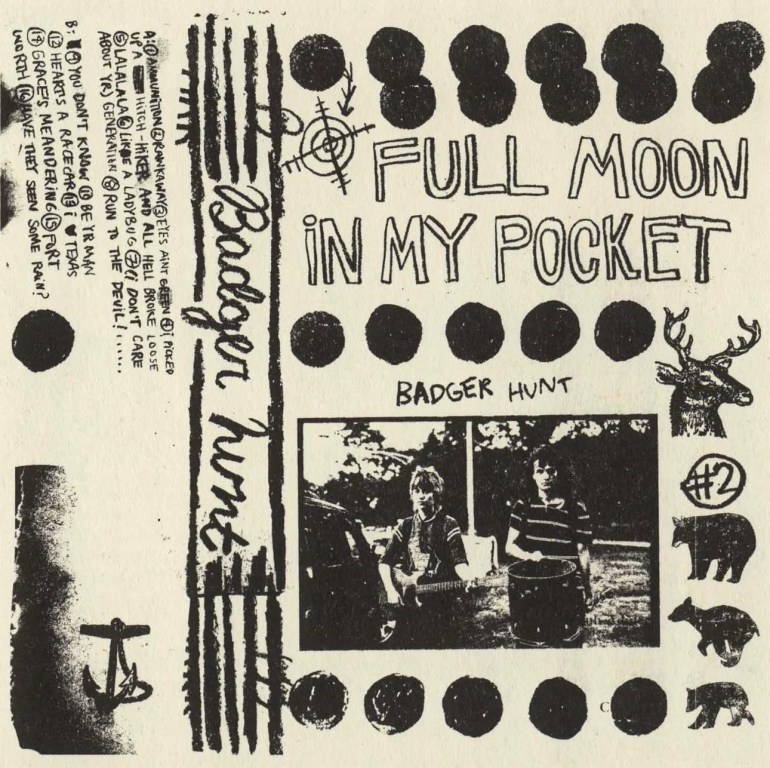
L: Speaking more on your LP, what was the process of it coming to life?
M: We recorded it in three days and we were only going to do like six songs. Then we realized, weirdly, that we had become the one-take wonders. Not all of the time, but it was pretty quick, because we were recording the guitar and drums live together, then I would sing on top of it. I remember they clicked play on the tape and it ran through all the songs in one go and I sang on all of them and then they were like, “okay done.” I was done singing in 45 minutes tops. Then we added the same guitar or changed it a little bit and then I added the tambourine and I had a bird whistle too. So we just got through a lot and then I was like, “L.O.L these little jams we play in practice, what if we recorded them just for sh*ts and gigs?,” and now we play a lot of those live. Then we sat on it forever because I was gone in Spain.
Our friends Grace Bader Conrad and Kai Slater recorded it for us and helped mix. Between them in Chicago, me in Spain and Jamie in New York, the communication was awful. But we got through in the end and thank god. They did it so well and it sounds so great. We’re super grateful for them and they’re our bros. Shoutout to them! Major shouts. Then after, the tapes took forever to come, we dubbed the tapes like three days before the release show, they showed up so late. We even added two songs at the last second and our friend Grace made an interlude out of a bunch of my voice memos like a week before it came out and then we were like, “ADD IT TO BANDCAMP BAH.” I love that about BandCamp, you don’t have to go through distrokid or anything. It almost feels like making a collage in a journal. It’s like your scrapbook. Anyway, it took a lot of work, getting the tapes, getting the CDs. Shannon burned our CDs, Leighton dubbed our tapes and then I risoprinted all the art and the packaging. It takes a while, it takes a lot of work. Then we had the show at ERF and our friends from Pound Booking helped us book it as well. That was fun and wonderful bands played there, including Guyscrapers [a NY band who also played at Alienated Majesty that same night]. Then we’re done, but it turns out it isn’t done because weirdly, people are buying stuff. I don’t know why, but they do! Random people are buying stuff and I keep needing to ship packages. Which is an awesome problem to have.
I really don’t like going to the post office, it stresses me out. I’ve had people at the post office on 4th Ave in New York accuse me of mail fraud. They were yelling at me, “we know what you’re doing! We know what you’re doing!,” and I was like, ‘I don’t know what I’m doing,” and I think that’s why I don’t like going to the post office anymore.
After our chat, we went back inside to enjoy the rest of the musicians, buy DIY merch, and browse books. The next day, I ran into Miles one last time at another unofficial show, giving out misprinted shirts for even cheaper than their already cheap price. Shortly after, they headed to the airport and returned to New York.
The Alienated Majesty show presented by Nitroglycerine was filled with a sweetness in the air created by the sense of community. Artists from Austin, New York and even Kentucky, filled the room with laughter and creativity. Now that time has passed, this show remains a fond memory of DIY and friendship found in the corporate chaos of SXSW.
Check out Badger Hunt’s LP on BandCamp or YouTube and keep updated with the band on Instagram @thebadgerhunters
Similar posts

-

1
In My Head
-
play_arrow
In My Head Phantogram & Whethan
-
-

2
Last Escape
-

3
Reason to Pray
-

4
Rabbit season
-

5
Still Do



Post comments (0)