
No One Is Right About Ariana Grande

Brooke Bousley
Music Journalist
Since the start of Ariana Grande’s Eternal Sunshine Tour, a large majority of the discourse online has centered on everything besides the music itself.
Inquiries regarding her appearance have continuously swarmed a plethora of social media platforms not only throughout the Wicked Promotional Tour, but have increasingly worsened since the initiation of her Eternal Sunshine Tour. Comment sections that contain speculations concerning her well-being, debacles over eating disorders, alongside predictions that she would be unable to withstand the physical demands of an arena tour that spans over two months. While some of the debates have been framed to derive from a place of concern, other talking points have been unabashedly cruel. Grande has previously addressed the discourse on multiple occasions, including a video posted to her personal TikTok account in 2023 and once more during the Wicked press tour in 2024, where she opposed the ideology in which strangers can precisely judge one’s wellness from an external perspective. Her point was concise: health and wellness are not linear, nor can they be gauged through a singular photo, era, or body type.
Following my attendance on Friday, June 26, and Saturday, June 27, of Ariana Grande’s Eternal Sunshine Tour in Austin, it immediately became evident that the internet’s narrative is not a meticulous reflection of reality.
For a duration of nearly two hours both nights, Grande maintained an exceptional level of vocal consistency while navigating ornate modifications of the stage and intricate choreography in 6-inch platform boots. Her endurance – one of the internet’s central points of contention prior to the tour – was not a noticeable flaw by any means. On the contrary, the evidence suggested otherwise.
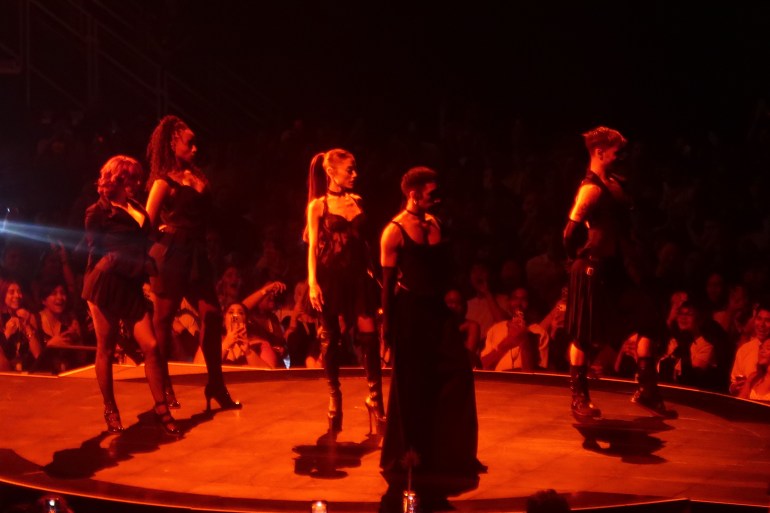
Her vocals had demonstrated a discernible degree of development, likely influenced by the years of classical vocal training required for her role as Glinda in Wicked. The shift in quality throughout the consecutive performances was made most apparent during “Dangerous Woman”, in which subtle alterations in terms of riffs and vocal runs were showcased by an artist who utilizes experimentation rather than merely matching the formerly recorded arrangement. Even throughout back-to-back performances, no two renditions replicated one another.
This particular observation has no intention to dismiss health-related troubles, but rather, it depicts the limitations that exist within the evaluation of any individual’s physical capabilities through the usage of edited images, viral clips, or oversaturated social media discourse.
The commentary encompassing Grande additionally unveils a larger cultural phenomenon: when female entertainers release new work, discussions regarding beauty standards or overall appearance often eclipse discussions in reference to the work itself.
In lieu of the analysis of vocal techniques, production, stage design, or songwriting, audiences have a tendency to sway towards critiques centered around appearance. The artist’s body becomes the headline, leaving the art itself as a secondary thought. This occurrence in question is where the distinction between concern and critique becomes an inevitably slippery slope.
Concern, at its foundational level, stems from the act of empathy, which engages with curiosity and honors comfortability. Critique, however, often assumes a certainty it hasn’t earned. In online spaces, the chain reaction can occur at nearly an instantaneous rate. A comment that expresses unease transforms into a barrage of speculations assigning a diagnosis based upon photographic documentation rather than the formulation of an in-person observation or a one-on-one conversation with the artist themselves. In Ariana Grande’s case, similarly to many other female artists, genuine care transforms into a generalized surmise. As has been proven time and time again, the internet rewards definitiveness, while forgoing nuance.
Furthermore, social media platforms are prone to amplifying and normalizing parasocial relationships – one-sided emotional connections fan bases develop with public figures. Artists themselves intentionally curate intimacy through the distribution of behind-the-scenes moments, anecdotal accounts, and personal interactions with fans. While these connections can concoct meaningful and intricate communities, they can, simultaneously, blur boundaries. In other words, the fans develop an illusory sense of a bond with an individual whom they will never know on an intimate level.
That perceived familiarity can foster a heightened sense of entitlement. If audiences feel emotionally invested in an artist, they might, in turn, feel just as entitled to disclosures regarding the individual’s private affairs, interpersonal relationships, or medical status. That being said, perceived intimacy does not equate to proximity or access that stems from authenticity.
Public figures consequently relinquish portions of their privacy through their existence within the spotlight. Despite this harsh truth, audiences are not owed any sort of confirmation or disclosures regarding private matters that occur in that particular public figure’s life.
At this juncture, entirely dismissing public concern would minimize the complexities at hand. Any sort of conversation revolving around eating disorders, unattainable beauty standards, and body imagine remain utterly crucial. Fostering a foundation for critical examinations and discussions can further encourage awareness, reduce stigmatization, and aid in the recognition of the deteriorating influence of idealized expectations. The core complication, however, resides not within the discussion itself, but rather in the manner in which it occurs. To put it simply, why we engage is merely the tip of the iceberg; how we engage is indicative of the overall outcome.
Nostalgic claims centered around the ‘old’ version of Ariana Grande are less about mourning a real aspect of her identity than about a curated persona that adhered to the limiting expectations placed upon her by the industry and her own fanbase. The eras that have been most noticeably romanticized – Sweetener (2018) and Thank U, Next (2019) – Grande herself had personally said, “I find it interesting that this has been one of the best years of my career and one of the worst of my life”, during her acceptance speech for Billboard’s Woman of the Year Award in 2018. Even this admission has been met with criticism and false claims from those who have no personal ties to her.
Perhaps this is why no one is right about Ariana Grande: conviction is effortless, but nuance requires acknowledging one’s humanity rather than diminishing it to serve an online narrative.

-

1
Last Escape
-

2
In My Head
-
play_arrow
In My Head Phantogram & Whethan
-
-

3
Reason to Pray
-

4
Rabbit season
-

5
Still Do



Post comments (0)