

The Cost of Control: How Engineered Sisterhood Fractures Girl Groups
Brooke Bousley
Music Journalist
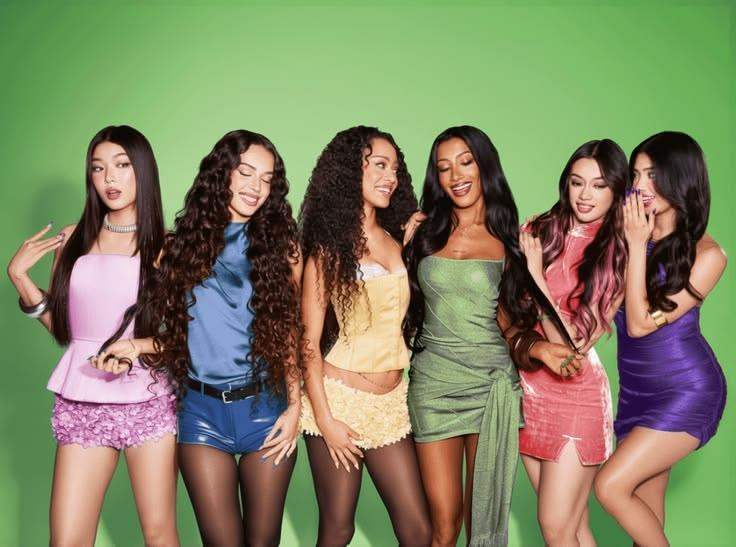
When Katseye made their first Coachella appearance back in April of this year, the vision that HYBE and Geffen had marketed to the general population via Dream Academy seemingly encountered an unexpected halt. Manon Bannerman, the group’s alluring visual, prolonged her absence following an official hiatus announcement — a narrative that read hauntingly familiar to those who had previous experience in monitoring girl group dynamics. While management had framed the reasoning for her time off to revolve around personal health-related qualms, the remaining members forged ahead as a quintet with little to no acknowledgement of the matter taking place. Not long after, another member, Sophia Laforteza, disengaged from group activities as a result of physical exhaustion. The media apparatus continued to churn, leaving fans, fondly referred to as “Eyekons,” to examine the dissonance that lies between corporate branding and reality. How can a group constructed upon the premise of everlasting sisterhood unravel at such a rapid pace?
In all actuality, the industry’s procedure intended for the formation of girl groups operates on a fundamental incongruity. The intention behind those who hold authority is to offer illusions of unwavering female bonds that operate within a parasocial framework whilst simultaneously upholding systems that foster exhaustion, isolation, and contention. Far from an aberration, the interpersonal conflicts occurring within Katseye mirror a broader systemic reality: a ruthless industry that feasts on the reduction of passionate individuals to short-term commodities.
Pop culture enforces a merciless expectation of emotional intimacy and vulnerability onto women in the music scene. Whilst male boy bands are granted the latitude to be chaotic and openly adversarial, girl groups are subjected to restrictive respectability politics. Women are not so much as gifted with the privilege of merely coexisting alongside one another as individuals who are proficient in their craft; they are tied to a state of perpetual devotion and ceaseless emotional availability amongst each other and their fanbases.
When an inevitable performance mishap takes place, perhaps an unintentional side-eye in an interview or the misinterpretation of body language cues — the internet becomes a sea of endless discourse dragging the members underneath the tides of unsought perspectives with no promise of resuscitation. Minor misfortunes are framed as character flaws, resulting in the collaborative environment metamorphosing into a harmful psychological environment that resembles that of a pressure cooker; teetering on the edge of demolition with every fleeting occurrence. Meanwhile, the members obtain an obligation to suppress any workplace-related conflicts and conserve the myth of sisterhood, furthermore, resulting in the festering of resentment beneath the impeccable exterior of the group’s reputation until the destined fate is succumbed to.
In order to further analyze the repetition of the collapse of girl groups, we must observe how these women are cast. Acts that operate under a manufactured structure are rarely constructed to operate impartially; instead, they convene around the basis of differing archetypes. These archetypes can include the Protagonist, The Proxy, The Wild Card, The Outlier, and The Glue.
This particular form of categorization was especially prevalent during Fifth Harmony’s tenure. Since the group’s inception on The X Factor, Camila Cabello was transparently positioned as the protagonist, which was further emphasized as she received a plentiful number of solo opportunities and gained ownership over the primary vocal lines, while the remaining members became tied to sparse supporting roles. Normani, who played the role of the outlier, underwent extreme racial harassment from digital spectators whilst attempting to navigate a brash and brittle environment where her talent was invariably underutilized. In the end, the social and economic incentives pushed Camila Cabello, the protagonist, to branch out independently, which inevitably obliterated the collective synergy and resulted in the residual participants assuming sole responsibility for the consequences that followed.

When it comes to K-pop idol pipelines and training methodology — a system that is currently being actively and intentionally distributed within Western markets through international projects — this specific tactic deviates into a more bittersweet territory. In other words, labels have a tendency to steer clear of the construction of a singular, prominent “star,” so individual member contains the ability to gain enough leverage to challenge executives, therefore reinforcing their submissive, non-abstainable position. Instead of garnering any aspect of artistic authority or general integrity, members of these girl groups become checkers in a game of chess, fortifying their duty as utilitarian components in a corporate scheme.
Additionally, when performers cease to withstand the physical and emotional strain of incessant schedules, restrictive diets or beauty standards, and particularly prejudiced isolation, she is simply labeled as “uncooperative” or “lazy.” All the meanwhile, the brand itself forges ahead, whilst public defacing is placed upon an individual’s perceived lack of discipline.
At the core of this convoluted crisis lies systemic sexism that runs rampant in an industry that operates under a patriarchal lens and is male-driven. Music conglomerates continuously exploit young women’s career-related aspirations or childhood dreams through the utilization of prohibitive contracts, dictations of physical appearance that could result in potential bodily modifications, and an overall governing over their public expression that is thinly veiled under the guise of mentorship and guidance.
Although we are led to believe the members contain an inseparable bond or portray particular traits within themselves or sprinkled throughout the overarching group dynamic, these entertainers are provided with scripted narratives that are written in corporate boardrooms which are starved of creative autonomy and thrive off of enterprise-wide betrayal.
Overall, girl groups are not destined to fail due to their incapability of engaging in a team-oriented setting, but failure has substantially become the end result due to their placement within an industrialized incubator that is structured to extract maximum profit whilst the soulful, autonomous frame perpetually rots. Until the music industry gains the ability to halt the prioritization of performative perfection over the agency of the performers themselves, the cycle will remain infinite: a glimmering debut, a fragmented promise, and an inescapable, significantly publicized fracture.
Similar posts


-

1
In My Head
-
play_arrow
In My Head Phantogram & Whethan
-
-

2
Last Escape
-

3
Reason to Pray
-

4
Rabbit season
-

5
Still Do




Post comments (0)